
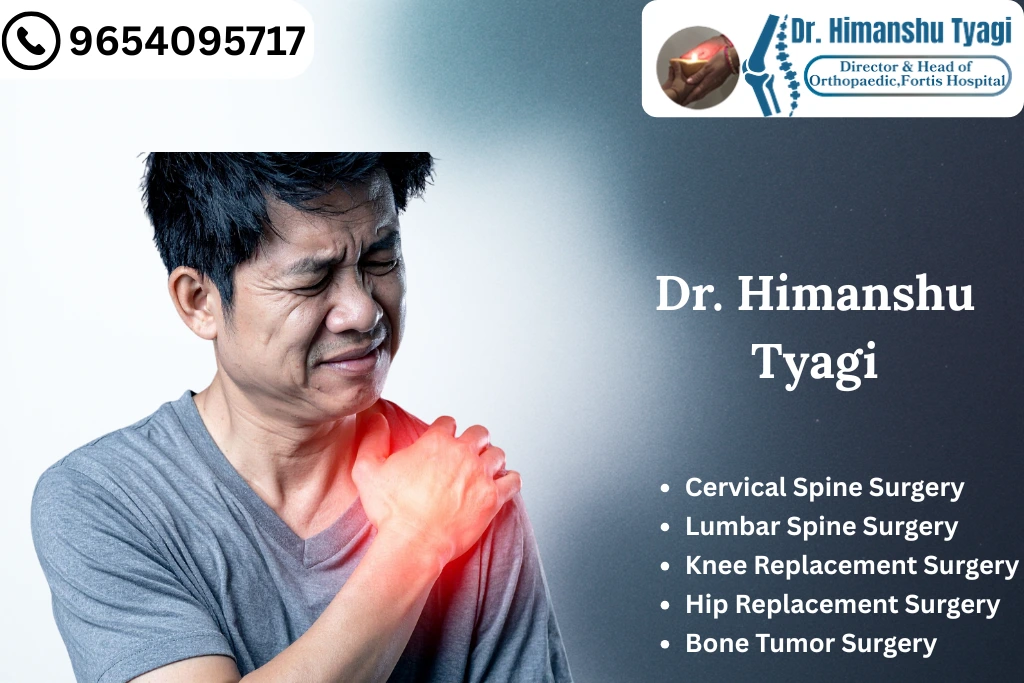
Fracturing a shoulder can be very painful and frightening, especially if it occurs suddenly from an accident or injury such as a fall or sports. People often ask themselves what they should do next: Do I need an X-ray? Do I need a cast? Will I need surgery? How long will it take to heal?
Understanding shoulder fractures can be confusing, so this blog will try to explain them in the simplest terms possible and provide the best treatment options available. If you live in the area of Noida, Sector 93B, you will also benefit from having available to you one of the finest medical professionals: Dr. Himanshu Tyagi, an Orthopaedic and Spine Surgeon with more than 15+ years of experience.
What Is A Shoulder Fracture?
When someone refers to a shoulder fracture, they are referring to the breaking of one or more of the bones of the shoulder joint. The shoulder is made up of three main bones:
- Clavicle (collarbone)
- Scapula (shoulder blade)
- Humerus (arm bone)
Of the three bones, fractures most commonly occur in the clavicle and the humerus.
Causes of Shoulder Fracture
Shoulder fractures can occur as a result of numerous different reasons, with the following being the most common:
- A fall on the shoulder
- A road traffic accident
- A sports injury
- Osteoporosis (in older adults, due to their weak bone structure)
- An injury due to a heavy trauma or a sudden, strong impact
- A simple slip in the bathroom may cause a fracture in an elderly person.
Signs of Shoulder Fracture
If you have sustained a shoulder fracture, you may experience the following:
- An intense amount of pain and discomfort that worsens with movement.
- Swelling and bruising around the area of injury.
- Difficulty in raising your arm above your head.
- A noticeable change in the appearance of your shoulder, either a deformation or a bulge in your arm.
- Hearing a grinding or popping noise as you attempt to move your shoulder.
- Weakness and/or numbness in the affected arm.
If you have any of the above symptoms, you should see an Orthopaedic and Spine Surgeon as soon as possible.
How is a Shoulder Fracture diagnosed?
A doctor will examine the injury site and check for movement and pain. Diagnostic tests include:
- X-ray (to assess the type and severity of the fracture).
- CT Scan (to assess the complexity of the fracture).
- MRI Scan (to assess injuries to soft tissues, i.e., ligaments and rotator cuff).
Dr. Himanshu Tyagi at Fortis Hospital and at Sector 93B will provide advanced imaging facilities, enabling a faster and more accurate diagnosis of your shoulder injury.
Shoulder Fracture Treatment Options
The type and severity of your fracture will determine how your doctor treats your fracture. However, generally speaking, the method used to treat the fracture depends on your specific case, including age and the severity of displacement of the bone. For example
Non-operative Treatment
Most shoulder fractures do not require surgical intervention. Many uncomplicated fractures can be treated conservatively with:
- Painkillers and anti-inflammatory medication to control pain and swelling
- Ice therapy to reduce swelling and pain
- Physiotherapy following initial healing to regain strength and movement
Dr. Himanshu Tyagi believes in choosing non-operative options whenever possible. He focuses on treating his patients without making them suffer.
Operative Treatment
Surgical treatment will be required for fractures involving:
- Displacement of the fracture
- Fractures with numerous fragments
- Fractures involving the joint
- Screws to fixate the fracture
- Shoulder replacement for severe cases (older patients)
At Fortis or at Sector 93B, we use modern techniques for our surgical procedures, which reduce recovery times and complications. Dr. Himanshu Tyagi is a recognised expert in using advanced techniques in shoulder trauma surgery and performs these operations with precision.
Why Dr. Himanshu Tyagi is the Best Choice for Shoulder Fracture Surgery?
One of the best things you can do if you live in Noida is to consult with Dr. Himanshu Tyagi, Senior Ortho Neurosurgeon with extensive experience in treating shoulder fractures at Sector 93B.
There are many reasons why Dr. Himanshu Tyagi receives such a large number of referrals from the community and is trusted by patients:
- He has extensive experience treating shoulder fractures and shoulder injuries.
- Conservative (non-surgical) management will be offered first before surgical options are explored.
- The approach is patient-focused, and he provides you with guidance throughout the entire process.
- He has an excellent reputation for fracture healing and rehabilitation.
Dr. Himanshu Tyagi’s clinic in Sector 93B has world-class capabilities, providing a safe, accurate, and comfortable method of treating every individual patient.
Final Thought
A shoulder fracture can be frightening; however, with the right physician and treatment options, recovery from a shoulder fracture can be quick and predictable. Finding a qualified surgeon who can provide an accurate assessment and provide expert guidance and treatment is critical when determining whether to use a simple sling or proceed with an extensive surgical procedure.
If you or a loved one has a shoulder injury or you suspect that your shoulder may be broken, it’s worth considering seeking out Dr. Himanshu Tyagi to get a more accurate diagnosis and find out what options are available for you.